Award winning filmmaker Nico Scheepers reflects on his journey through film
17 July 2026
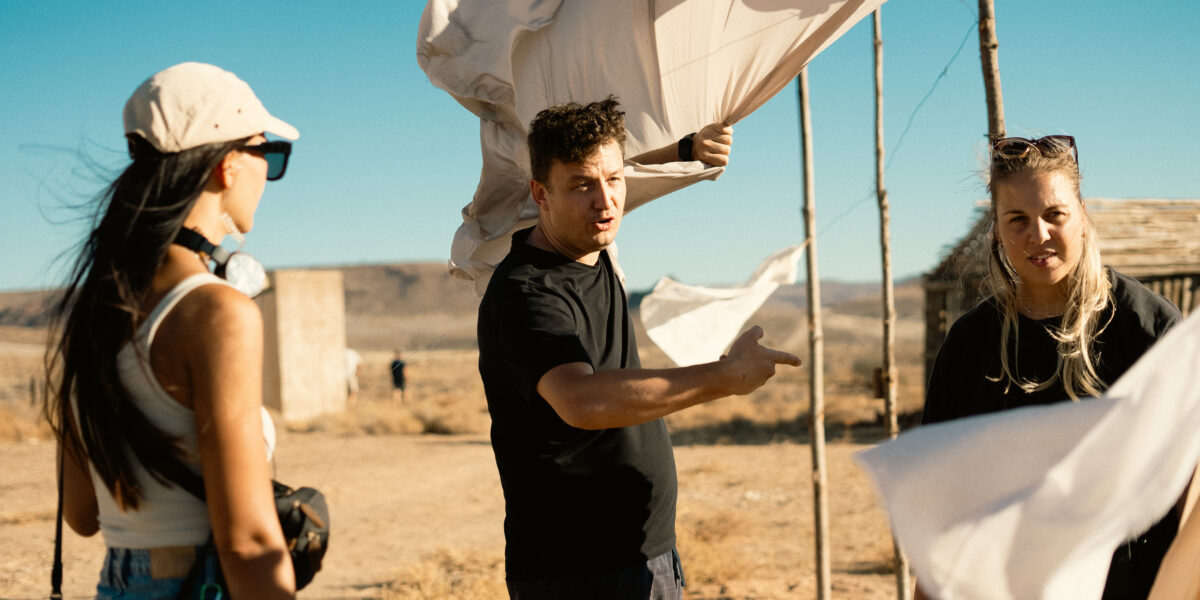
Award-winning filmmaker Nico Scheepers has built a remarkable career earning recognition for his distinctive storytelling and compelling visual style. In this Q&A, he reflects on the journey that shaped his creative voice, the making of HEN, the importance of collaboration, and his hopes for the future of South African cinema.
Q. You’ve built a career across theatre, television and film, looking back, what first drew you to storytelling, and what has kept you passionate about filmmaking?
I vividly remember the first time I was forced to read a book. I was six years old, a proper Limpopo farm boy, and about to start school. We lived too far out of town for the daily commute and could not afford the hostel, so during the week I moved in with an aunt I barely knew in town. She was my father’s sister, an English teacher at the local school, and one of the best things that ever happened to me.
She told me that the television was broken every afternoon, and that I could either sleep or read. After two weeks of drowsy boredom, I went to the bookshelf and, of course, chose the only novel with a dragon on the cover. The Hobbit was far above a first-grader’s reading level, but to her infinite credit, she put aside her own novel, made space for me on the bed beside her, and we began reading Tolkien together.
Her real magic, though, happened between the words. After every page, she would pause, close the book and ask me questions. “He didn’t tell us the colour of Bilbo’s boots, did he? What do you think they look like?” She trained me to think in story: to observe, to imagine, to describe and to remain curious about everything. For that, I will always be grateful.
A film begins with something invisible in one person’s mind, and through collaboration it becomes a world that other people can enter. Theatre, television and film all offer different ways of doing that, but cinema continues to thrill me because every choice matters: a face, a silence, the movement of a camera, the space around a character. There is always another way to tell the story, and always more to learn.
Q.How do you approach developing an idea from its earliest concept through to the final edit?
This is always one of the most difficult questions to answer, because the process is completely different for something on a stage and something on a screen.
When I am writing or devising a play, I tend to work from the inside out. I build character and theme through dialogue, suggestion, rhythm and breath, inviting the audience to do much of the imaginative work. Theatre is an active exchange. The audience completes the world with you.
With film and television, I work from the outside in. I usually begin with images, spaces, textures or fragments of behaviour, and slowly assemble them into a tapestry for the audience to experience. It is almost as though, when I write prose or theatre, I imagine myself as the heart or spirit inside a thing; when I write for the screen, I imagine myself as the camera. I observe. I decide where to look, what to reveal and what to withhold, and I record those observations in the screenplay.
Once pre-production begins, that private act of imagining becomes collaborative. The screenplay remains the blueprint, but the cinematographer, actors, production designer, costume designer, composer and every other department begin colouring in the world. The idea inevitably changes as it passes through other people’s imaginations, and part of directing is knowing what must be protected and where the work should be allowed to surprise you.
The edit is where I return to the essential story. By then, you are no longer making the film you imagined or even necessarily the film you shot. You are making the best film that exists in the material. It becomes a process of listening: to performance, rhythm, silence and the emotional movement between images. Very often, the final film reveals what the original idea was truly about.
Q. As a filmmaker from Cape Town, how has the city’s creative community and production landscape influenced your work?
I have lived in Cape Town for thirteen years, and I am still struck by its beauty and generosity every day. It is a city of extraordinary contrasts, with an incredible range of landscapes, architecture, languages and communities compressed into a relatively small space. For a filmmaker, that makes it endlessly stimulating. It constantly offers new worlds to observe.
More than anything, though, Cape Town has given me a creative family. My producer and friend, Chanél Muller of Nagvlug Films, has a particular superpower: nobody is better at bringing together teams of people who become family. I have worked with more or less the same crew across Nêrens, Noord-Kaap, Donkerbos, HEN and Landmyn, and I would gladly collaborate with every one of them again on the next project.
They are kind, talented people from vastly different backgrounds who have grown into what we now think of as the Nagvlug family. There is an enormous amount of skill in Cape Town’s production community, but also resilience, generosity and a willingness to make ambitious work with limited resources. We do not get paid enough not to love the process, and on a Nagvlug Films set, that has never been a problem.
I am eternally grateful to every person who has helped make these stories possible. Whatever is personal in the work may begin with me, but the films themselves belong to the community of people who bring them to life.

Q. The horror genre has been gaining momentum in South African cinema. What opportunities do you think it presents for local filmmakers, and how does HEN contribute to that growing landscape?
Horror gives South African filmmakers an extraordinary opportunity because it allows us to tell culturally specific stories in a language that travels. The genre is inherently cinematic, but it is also flexible enough to hold our history, our anxieties, our folklore and the realities of the country we live in. We do not have to imitate international horror films. The more particular and recognisably South African the story is, the more distinctive it becomes on the world stage.
There is also a practical opportunity. Horror can often be made at a contained scale, without sacrificing ambition, and audiences and festivals are increasingly receptive to bold genre work from places they have not seen represented before.
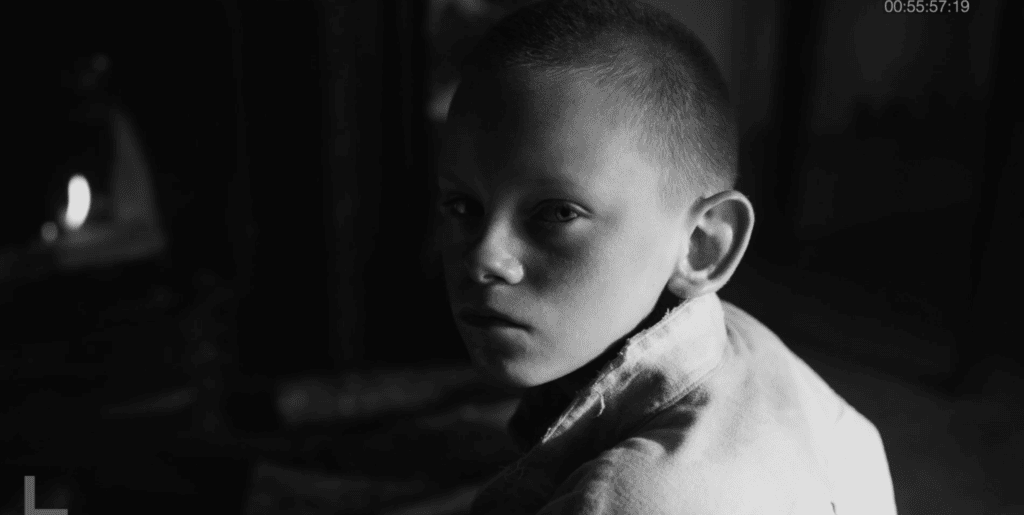
With HEN, I wanted to contribute something quieter and more psychological to that landscape. It is rooted in a very specific South African world, but it uses horror to explore universal ideas about faith, family, inherited trauma and our instinct to protect a child even when we begin to fear him. I hope the film demonstrates that South African horror can be formally daring, emotionally complex and deeply local, while still connecting with audiences far beyond our borders.
Q. What qualities do you value most when building a creative team, and how do you foster collaboration on set?
Above all, I value teamwork and collaboration. I do not care how talented someone is, what their credentials are or how many awards they have won. If they cannot set aside their ego and work as part of a team, then we will not work together.
My friend and colleague Beer Adriaanse often says, “Oorlewing is ’n spansport”, survival is a team sport. I believe this completely. Filmmaking is too difficult, too exposed and too dependent on trust for anyone to think they are more important than the work or the people around them. This applies to the cast, the crew and, perhaps most importantly, the director.
I want people to feel free to bring ideas, ask questions and challenge something if they believe there is a better way. But collaboration does not mean creating by committee. One of the most difficult parts of directing is having to say no to someone’s idea, especially when it comes from real thought, talent and hard work. The right collaborators understand that this is not a rejection of them. They understand that the director has to steer the ship, and that there is only one king on set: the story.
That trust is essential. It allows people to offer their best without becoming possessive about whether every idea survives. My responsibility is to listen openly, make the decision and protect the film as a whole. Kindness and respect remain non-negotiable. A set has its own emotional ecosystem, and one difficult ego can affect everyone. To put it less delicately: even a speck of shit in a large pot of soup means there is still shit in the soup.
The best work happens when people feel safe, valued and united by the same goal. That is the environment we try to create.
Q.What was one of the biggest creative or technical hurdles you faced while making HEN, and how did you overcome it?
During the shoot of the second season of Nêrens, Noord-Kaap, we discovered a beautiful abandoned farmhouse. It had no electricity, no running water and was nearly fifty kilometres from the nearest town, reached by a long stretch of badly neglected dirt road. Naturally, we decided we had to shoot there.
Making HEN in that degree of isolation, often in forty-degree heat, was both the greatest challenge and one of the greatest blessings of the film. Every practical decision had to be carefully planned because nothing could be solved quickly. We had to arrive prepared, work with what we had and rely completely on one another.
There was also no cellphone signal, which meant that, during takes, there was nowhere else for anyone’s attention to go. The entire cast and crew were present, focused on the story and on each other. That concentration created an energy you could feel on set, and I believe it found its way into the film.
The isolation stopped being merely a logistical hurdle and became part of the creative process. The farmhouse, the heat, the silence and the sense of being cut off from the outside world all shaped the atmosphere of HEN. In the end, the conditions we had to overcome became inseparable from the film we were trying to make.
Q. Is there a project or experience that fundamentally changed the way you approach storytelling?
Working closely with our local crews, and coming to know and care for them as people, has fundamentally changed the way I write for film and television. It is a lesson I learnt from my producers at Nagvlug Films, Chanél Muller and Zandré Coetzer: care about the people who need to care about your story.
It has not made me less ambitious at the inception of a project, and I never want budget to determine the limits of the imagination. But once the work begins moving towards production, I see it as part of my responsibility as the storyteller to shape the material around the realities of time, working hours and safety on set.
That does not mean compromising the story simply to make it cheaper. It means understanding that every scene has a human cost and asking whether that cost is necessary. By making those decisions on the page, before production begins, I am already contributing to the collaboration and caring for the people who will eventually have to bring the work to life.
I no longer think of compromise as a failure of ambition. Limitations often make us more precise, inventive and creative. Some of the best decisions I have made were born from asking not only, “What would be extraordinary?” but also, “How can we achieve it without exhausting or endangering the people making it?”
Q. What do you think is needed to help local filmmakers continue producing stories that resonate both at home and internationally?
We need a functioning Department of Sport, Arts and Culture that genuinely invests in local artists, infrastructure and long-term industry growth, beyond the important work institutions such as the NFVF are already doing with limited resources.
The collapse of confidence in the Department of Trade, Industry and Competition’s film rebate system has been devastating. It exposed just how fragile the support structure beneath our industry really is. Filmmakers cannot build sustainable careers, companies cannot plan, and international partners cannot invest with confidence when essential funding mechanisms are unreliable.
South Africa has too much talent and too many stories to allow this industry to wither. South Korean films and series are visible across global streaming platforms and cinema screens not because their filmmakers have infinite resources, but because their government recognises the value of culture, storytelling and soft power, and invests accordingly.
South Africa already has the talent, the locations, the crews, the languages and the stories to compete at that level. The creators are ready. The starter pistol is raised. The question is: where is our national government?
Q. What excites you most about the future of South African cinema, and where do you see the industry heading over the next five to ten years?
Variations on a Theme winning the Tiger Award in Rotterdam, Koek being nominated for an Emmy, and now HEN winning at NIFFF all suggest the same thing: the world is ready, and hungry, for South African stories.
What excites me is that these are not enormous, prohibitively expensive productions attempting to imitate Hollywood or European cinema with a fraction of their resources. They are distinctly South African stories, made within South African means.
That does not mean they lack ambition. It means the ambition lies somewhere else: in the specificity of the world, the strength of the writing, the performances, the images and the point of view. Rather than chasing the technical spectacle made possible by monstrous budgets, we are increasingly embracing smaller, more personal things made by human hands.
I believe that is precisely what is drawing the international eye towards us, all the way at the tip of Africa. Over the next five to ten years, I hope we become even more confident in that identity: not asking how we can make films that resemble those from elsewhere, but recognising that the stories only we can tell, made in the way only we can make them, are our greatest strength.
Q. Finally, what’s next for you? Are there any new projects, genres or stories you’re excited to explore in the near future?
We are currently developing several new projects. I am writing my first novel alongside a new drama series set in the Western Cape, and we are preparing my third feature, a contemporary psychological thriller that will be shot at home in the City of Cape Town. At present, we are securing the funding to make it possible.
The fact that my debut feature is a horror film does not mean we only want to make horror films. My second feature, Landmyn, is an intimate chamber drama about a family. The third is a psychological thriller. I hope the fourth is science fiction, the fifth a proper fantasy, and so on and so on until someone finally tells us to stop.
What excites me most is moving between forms, genres and scales without losing the people who have helped shape the work. I never want to repeat the same film simply because it worked once. I want us to remain curious, keep learning and allow every new story to demand a different language.
Whatever genre we tackle next, I want my film family beside me. The worlds may change, but the joy is in building them together.


